

Years ago, I was traveling to a rather remote western city for a musical engagement. I had brought my guitar in a substantial, rather heavy case. The weather was lovely, and in those days, some airports had outdoor baggage conveyors where passengers could watch their luggage being transferred from the aircraft. As I waited for my guitar, I noticed several baggage handlers placing suitcases onto the conveyor. Part of the machinery obstructed my view, so I could see only their legs and the luggage as it appeared. Most were lifting and placing the bags onto the belt, but one person was literally dropping them, with an alarming thud each time. When that worker bent over, I could see that she was a woman. Then came my guitar. She lifted it and dropped it onto the conveyor with such a thud that I was horrified! I was angry, disappointed, and terribly concerned about my instrument. Fortunately, it survived undamaged.
That experience stayed with me. I wondered whether this worker had been assigned a task poorly suited to her physical capacities, whether she had received adequate training, or whether something else explained what I’d witnessed. I certainly wasn’t suggesting that women cannot handle heavy luggage. Many can (I’m rather girly and burly myself!), just as some men cannot. Whatever the cause, the consequences were potentially being borne by travelers and their belongings. The issue was whether the person performing the work was genuinely equipped to do it appropriately and safely.
Since then, I’ve purchased a particularly well-padded, TSA-approved guitar case, and thank G-d I did! My guitar has endured other unfortunate baggage-handling incidents, and that fortified case has served it well. Apparently, anything with a heart needs a little armor when traveling through the modern wilderness of airline baggage handling. But beyond concern for my faithful guitar, the experience raised a larger question: How often do we place people in roles without adequately considering their strengths, limitations, or suitability for the work? And how often do the resulting struggles affect everyone who depends upon them? Well-intentioned efforts to broaden opportunity can still go awry when individual capabilities and appropriate preparation are overlooked. Guitars, and other loving things, may suffer the consequences!
Recently, I came across a delightful quotation that brought that experience back to mind: “If your soul isn’t dancing, change the song.” Being someone who loves music, metaphors, psychology, and Torah, I couldn’t resist playing with it. It reminded me of another familiar saying: “If you do what you love, you’ll never work a day in your life.” Both sentiments are lovely, although perhaps simplistic. Even when we’re doing what we love, there’s plenty of work involved. The musician practices scales; the writer revises sentences; the teacher prepares lessons; and the parent who adores her children still changes diapers. Loving what we do doesn’t eliminate effort. It changes our relationship with the effort. And that distinction opens the door to a fascinating conversation about motivation, mastery, and the unique gifts Hashem has given each of us. We choose our challenges, too. Stay tuned for an upcoming Substack on the “Chosen Challenge!”
THE DIFFERENCE BETWEEN CHALLENGE AND MISALIGNMENT
I’ve long been intrigued by the relationship between challenge and growth. We need challenges to develop our abilities, and mastery requires repetition, persistence, occasional frustration, and a willingness to stretch beyond what comes easily. There’s a familiar saying that there’s no growth in the comfort zone and no comfort in the growth zone. Although growth need not always be uncomfortable, there’s an important truth here. Too little challenge can become boring, while too much can overwhelm us. Somewhere in between lies meaningful engagement, learning, and mastery. But what happens when practically everything we’re doing is a struggle? When the entire job, rather than an occasional aspect, requires us to operate against our natural abilities, temperament, interests, or values? We may be working extraordinarily hard without experiencing the satisfaction that accompanies developing our strengths. Instead of stretching our abilities, we’re continually wrestling with a mismatch. And wrestling, as anyone who’s attempted to put a fitted sheet on an uncooperative mattress knows, can be exhausting without being particularly enriching!
Psychology gives us useful language for this. Self-determination theory emphasizes autonomy, competence, and relatedness in human motivation. Research on person-environment fit examines how compatibility between individuals and their surroundings influences satisfaction and well-being. Psychologist Mihaly Csikszentmihalyi in his book Flow, described the state of absorbed attention that can emerge when challenges and skills are well matched. We lose track of time, not because we’re doing nothing, but because we’re completely engaged.
Of course, natural talent isn’t the same as immediate ease. Some of our greatest gifts require tremendous work to uncover and refine. Difficulty doesn’t automatically mean unsuitability. The distinction often becomes clearer over time. Does the struggle produce growing competence, engagement, and accomplishment, or continually consume energy without allowing our strengths to develop? There’s a difference between climbing a mountain that calls upon your abilities and spending your life pushing against a locked door. Which brings me to a Torah concept that adds another dimension to our musical metaphor: avodas perech, the crushing labor imposed upon the Jewish people during their enslavement in Egypt.

AVODAS PERECH: WHEN THE WORK DOESN’T FIT THE WORKER
The Torah describes how the Egyptians embittered the lives of the Jewish people with hard labor. In Sotah 11b, the Gemara explores the expression b’farech. One interpretation emphasizes crushing, backbreaking labor. Another derives it from b’feh rach, meaning “with a soft mouth,” describing how the Egyptians initially enticed the people into labor before tightening their control. But there’s another remarkable explanation. Rabbi Shmuel bar Nachmani, quoting Rabbi Yonatan, teaches that the Egyptians exchanged the accustomed work of men and women, imposing upon each the tasks ordinarily performed by the other. (Pharaoh imposed labor, kind of like my guitar story above 😁)
Think about that! The cruelty wasn’t limited to the intensity of labor. It involved a deliberate mismatch between the work and the worker. In the historical context described by the Gemara, these assignments disregarded people’s accustomed roles and experience, adding to their suffering. Rashi’s commentary underscores the hardship of being assigned work outside one’s customary role. This doesn’t mean tasks should be assigned according to rigid gender assumptions, nor that abilities can be determined by gender alone. The teaching describes a system deliberately designed to make labor burdensome. Its broader psychological implications invite us to consider the relationship between demands and capacities.
Suddenly, my experience watching those baggage handlers takes on another dimension. Perhaps that worker was capable of the task and simply performed it carelessly. Perhaps the work was too demanding, or she lacked appropriate equipment or training. I could not know these things. But the possibility of a mismatch was difficult to ignore. Of course, the brutality of Egyptian slavery should never be equated with ordinary contemporary frustrations. Yet the underlying principle offers a striking parallel. Sometimes the burden isn’t simply the amount of work. It’s the persistent misalignment between the person and the work being demanded. A task that comes naturally to one person may require enormous effort from another. When that mismatch dominates our daily experience, the frustration can become more exhausting than the labor itself.
There is a difference between work that develops our capacities and work that continually frustrates their expression. One stretches us toward competence. The other may leave us forcing a square peg into a round hole, exhausting ourselves while potentially compromising the quality of our contributions. Not every uncomfortable task is inappropriate, nor is every unfamiliar responsibility a form of avodas perech. Learning necessarily involves awkwardness, uncertainty, and frustration. Even gifted musicians hit wrong notes. The question isn’t whether an activity is difficult, but whether the difficulty helps us develop or perpetually prevents us from using our abilities. Are we working hard because we’re growing, or because we’re continually working against ourselves?
THE PEARLS AND THE BREAD
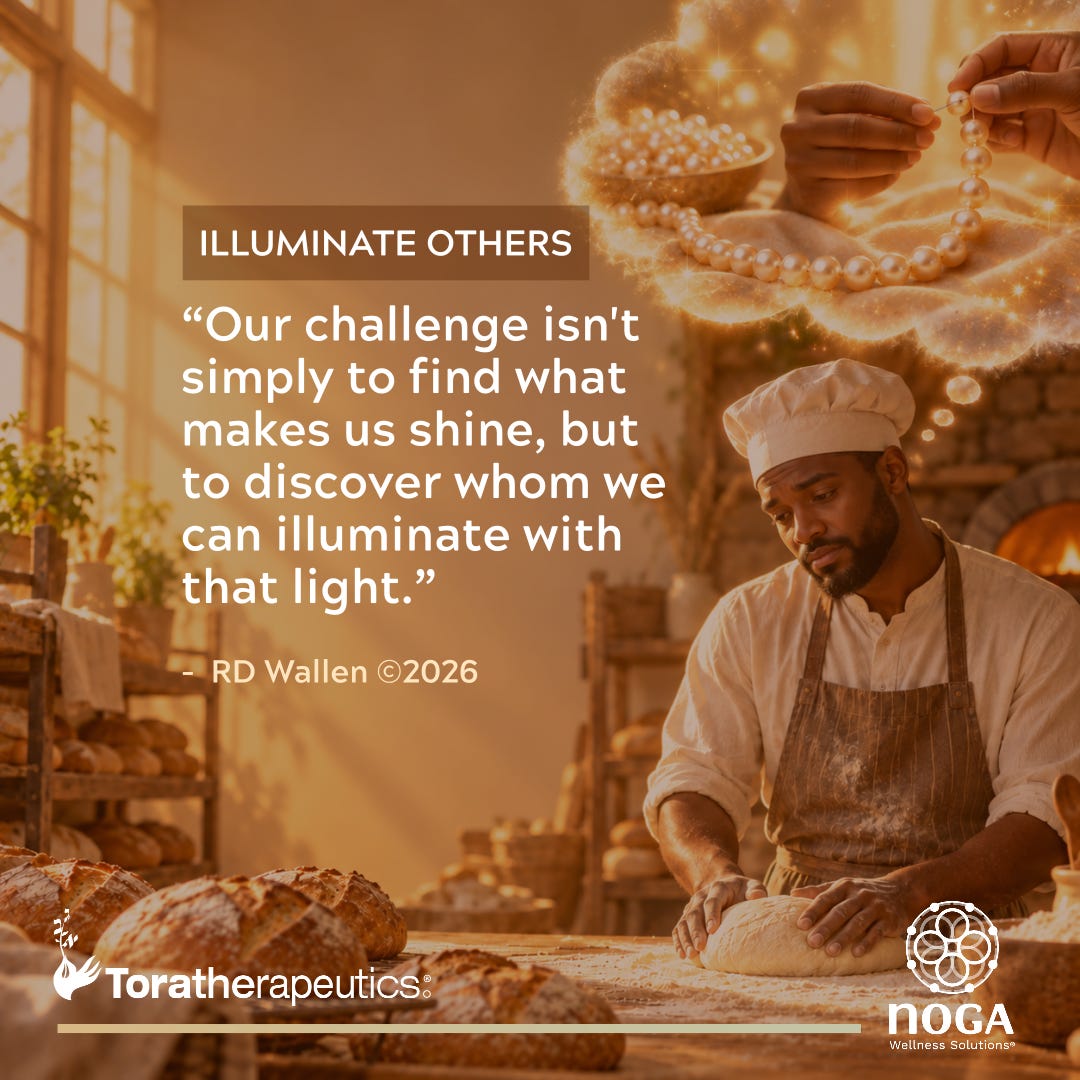
This reminds me of a beautiful teaching in Hayom Yom, the entry for 25 Nissan, the tenth day of the Omer. It explains that a person’s avodah (work, labor) should correspond to their nature and innate qualities. It gives the example of someone capable of drilling pearls or polishing precious stones who instead occupies himself with baking bread. Bread baking is necessary and honorable work, yet for this particular individual, neglecting his specialized capabilities is described as a cheit - a deficiency or falling short of what he could accomplish.
What a remarkable idea! There’s nothing wrong with baking bread. In fact, the world would be in serious trouble without bakers. But if someone has a unique capacity for polishing precious stones and spends an entire lifetime doing something that never allows that gift to develop, something valuable may remain unrealized. Conversely, another person may possess an extraordinary gift for baking bread. (And in Buffalo, where there is a dearth of Kosher bread to purchase, my Sourdough baking genius friends mean a LOT to me). The same work that’s misaligned for one person may be precisely right for another. (I am a great cook; come and taste. But a baker, I am NOT!
The message isn’t that some occupations are inherently more spiritual or important. It’s that each person possesses a particular combination of gifts, inclinations, experiences, and opportunities. Our responsibility includes discovering how best to use what Hashem has entrusted to us. We aren’t all meant to polish diamonds, and we aren’t all meant to bake bread. A world filled exclusively with diamond polishers would be beautiful to admire, but we’d probably be rather hungry! Hayom Yom is speaking primarily about spiritual service, not prescribing a career test. Yet its analogy invites a broader reflection. We need to consider not only whether we’re doing something worthwhile, but whether we’re meaningfully using the particular capacities we’ve been given. And perhaps this is where we can ask a particularly important question: What gives you your shine?
WHAT GIVES YOU YOUR SHINE?
I like that expression because shine isn’t quite the same as happiness. Happiness is an emotional experience, often influenced by circumstances. Shine is something more enduring. It’s what happens when we express a capacity especially suited to who we are. We become engaged, curious, energized, and alive to possibilities. The work may still be demanding, but something about it feels deeply congruent with our abilities and values.
And here’s where Chassidus offers a remarkable play on a single word. In Shabbos 118b, Rav Yosef asks the son of Rabbah, “Avuch b’mai zahir t’fei? - In which mitzvah was your father especially careful?” His response was was tzitzis. But Chassidus invites us to hear another dimension in zahir. Not only careful or vigilant, but shining, through its association with Zohar - illumination. In this interpretive light, Rav Yosef is asking Rabbah’s son, in which mitzvah did his spirit shine most brightly? The Alter Rebbe develops this concept in Tanya, Iggeres HaKodesh, Epistle 7, explaining that although we’re obligated in all the mitzvos applicable to us, each neshama has a particular spiritual connection through which a distinctive Divine light is revealed. There may be a mitzvah that especially illuminates the soul, an avenue of avodas Hashem through which something uniquely its own finds expression.
Isn’t that an extraordinary way to consider our individual gifts? What makes us shine? Not merely what makes us happy or wins applause, but what awakens something meaningful within us? What capacity, when developed and put to good use, allows us to illuminate the world? Although the Chassidic teaching concerns mitzvos and spiritual service, it also offers a beautiful lens through which to consider the abilities Hashem has entrusted to us. Perhaps discovering our gifts isn’t merely about personal satisfaction. Perhaps it’s part of discovering the light we’re meant to bring into the world.
We can often recognize this quality in others. Watch someone gifted at comforting a frightened child, teaching a difficult concept, repairing an intricate mechanism, composing music, cultivating a garden, or bringing warmth into an uncomfortable gathering. Something comes alive in them. Their concentration sharpens, their responsiveness increases, and their efforts have a natural fluency. What might be tedious to someone else becomes absorbing to them. And not every gift is dramatic or publicly celebrated. Some people listen remarkably well. Others instinctively notice what needs repairing, who needs including, or where a little humor could transform an uncomfortable situation. Some possess extraordinary patience, ingenuity, creativity, or the ability to recognize potential in others. We sometimes overlook our gifts precisely because they come so naturally. What seems ordinary to us may be extraordinary to someone else. This suggests a wonderful responsibility toward one another: helping people recognize gifts they haven’t yet discovered. A parent, teacher, friend, mentor, or therapist may notice a spark that its owner considers unremarkable. Sometimes another person’s encouragement is the invitation needed to develop that capacity.
As therapists, part of our work is helping clients recognize strengths they may not realize they possess and encouraging them to cultivate those gifts. Some have spent so much of their lives struggling with perceived shortcomings, accommodating others’ expectations, or trying to become someone they were never meant to be that they’ve lost sight of what comes naturally. Therapy isn’t only about alleviating suffering or correcting what’s wrong. It’s also about discovering what’s working, identifying overlooked capacities, and creating opportunities to express them. Sometimes we see a client’s shine long before she recognizes it herself. What a privilege to help someone discover that the qualities she’s taken for granted may be among her greatest gifts!
Discovering our gifts doesn’t mean insisting that every gift become our livelihood. Many people cannot simply abandon responsibilities that support their families. Sometimes bread baking pays the bills while pearl polishing takes place after hours, through learning, creativity, volunteering, teaching, or helping another person. A meaningful pursuit needn’t generate income to generate value. We need enough challenge to develop our gifts, enough humility to perform the tasks that life requires, and enough self-awareness not to confuse perpetual struggle with meaningful growth. Perhaps our goal isn’t to live a life in which the soul is constantly dancing. That would be an impossible demand, and a rather exhausting choreography! Perhaps the goal is to live in such a way that the soul recognizes its own music. To recognize when the melody is true, even when it’s difficult. To recognize when we’ve mistaken applause for meaning. To recognize when we’re exhausted rather than uninspired. And to recognize when the time really has come to change the song.
Enjoy my Suno Song:
IF YOUR SOUL ISN’T SINGING, CHANGE THE SONG!
The opposite of avodas perech is not a life without effort. It is a life in which effort has purpose, and the individual has an opportunity to bring their unique gifts into that purpose. After all, the soul doesn’t necessarily object to working hard. Sometimes it simply longs to make music while it works. And here’s the thought I keep returning to: Hashem didn’t give us gifts merely to admire them. He gave them to us to develop, to use, and to share. Our challenge isn’t simply to find what makes us shine, but to discover whom we can illuminate with that light. Not every difficult passage means we’re playing the wrong song. But if we’ve spent our whole lives struggling to play somebody else’s instrument, perhaps it’s time to discover the one Hashem placed in our hands. And perhaps the sweetest discovery is that when we finally find our own song, other souls begin to sing along with us. Then our soul really begins singing!

REFERENCES
Csikszentmihalyi, M. (1990). Flow: The psychology of optimal experience. Harper & Row.
Deci, E. L., & Ryan, R. M. (2000). The “what” and “why” of goal pursuits: Human needs and the self-determination of behavior. Psychological Inquiry, 11(4), 227–268. https://doi.org/10.1207/S15327965PLI1104_01
Kristof-Brown, A. L., Zimmerman, R. D., & Johnson, E. C. (2005). Consequences of individuals’ fit at work: A meta-analysis of person-job, person-organization, person-group, and person-supervisor fit. Personnel Psychology, 58(2), 281–342. https://doi.org/10.1111/j.1744-6570.2005.00672.x
Schneerson, M. M. (Comp.). (1943). Hayom Yom, 25 Nissan. Kehot Publication Society. https://www.chabad.org/therebbe/article_cdo/aid/6167/jewish/Hayom-Yom-Nissan-25-10th-day-of-the-omer.htm
Schneur Zalman of Liadi. (n.d.). Tanya, Iggeres HaKodesh, Epistle 7. Kehot Publication Society.
Babylonian Talmud, Shabbos 118b.
Babylonian Talmud, Sotah 11b, with Rashi’s commentary. https://www.sefaria.org/Sotah.11b
Exodus 1:13–14.
Beautiful and so on point!
I need to read this again...there were so many deep and broad points that resonated with my brain, heart, and soul...I need to hear/feel/think them through once again. Ya'asher koach, Rus Devorah!