

When I was younger, there was a national campaign called “Just Say No.” It became one of the defining slogans of the War on Drugs era, publicly championed by First Lady Nancy Reagan. The genius of the phrase was its simplicity. Someone offers you something harmful. You say no. End of story.
If only nervous systems were that cooperative. We now understand that addiction involves reward circuitry, stress, trauma, conditioning, social context, and the human desire to relieve distress. The brain does not reorganize itself because someone printed a catchy phrase on a T-shirt. Still, I have always heard the slogan echo in my head. Recently, I began playing with it; it became, “Just say no to... thugs.” Not actual criminals lurking in dark alleyways, although saying no to them remains sound public safety policy. I mean the quieter thugs: the people, habits, obligations, interruptions, expectations, and internal pressures that repeatedly mug us of time, attention, energy, regulation, and sometimes sanity. I call them nervous-system thugs.
MEET THE THUGS
A thug can be a person who repeatedly offloads responsibilities that properly belong to them. It can be a task wildly mismatched to your skill set, an emotional ambush five minutes before you need to leave, or a meeting that consumes ninety minutes and produces no evidence that civilization has advanced. A thug can also be the person who repeatedly says, “Let’s schedule,” so you rearrange your day, hold the time, prepare mentally, and then they cancel…Again. Eventually, you are not maintaining a relationship. You are running a small unpaid reservation service. Individually, these incidents can seem trivial. Ten minutes here. Another interruption there. Another “quick question,” a phrase that has rarely foretold anything quick. The problem is not always injury. It is fragmentation.
THE NEW ROBBERY
Some of the most valuable things we possess are not stored in a bank. They are attention, cognitive bandwidth, sleep, emotional availability, creativity, time, and presence. Modern life is exquisitely designed to make us forget that these are finite. Notifications, alerts, messages, and endless digital cues repeatedly pull the brain away from one task and toward another. Each shift requires evaluation, inhibition, and reorientation. The thief may not take the whole afternoon, but he robs you in many nickels. Our nervous systems are predictive. They are constantly asking: What is happening? What comes next? Do I need to mobilize? Is this safe? Does this require action? That is why chronic ambiguity is costly. Repeated scheduling and cancellation, shifting demands, and constant low-grade interruption force the brain to keep updating its expectations. Chronic stress and cognitive overload can weaken the executive functions needed for planning, inhibition, discernment, and flexible decision-making. And there lies the paradox: the more depleted we become, the harder it becomes to protect ourselves from depletion.
REFUSAL REQUIRES CAPACITY
Saying no is therefore more than a social skill. It is regulatory. Refusal may require us to interrupt an automatic response, tolerate another person’s disappointment, resist guilt, and remain anchored to our values while the emotional system protests: “They will think I am selfish. They might be angry. I should be able to handle this. They need me. Good people say yes.” And so, we say yes with our mouths while some deeper part of us is already objecting. Resentment is sometimes the nervous system’s collection agency. It arrives later to collect the debt incurred when we agreed to something we did not truly have the willingness, capacity, or integrity to give. Sometimes the problem is not that another person violated us. Sometimes we said yes when we meant no.
MO’ACH SHALIT AL HALEV
Chassidus gives us a powerful language for this. In Tanya, chapter 12, the Alter Rebbe discusses mo’ach shalit al halev, the mind’s preeminent capacity to govern the heart. This does not mean suppressing emotion. The beinoni, the “intermediate” person whose impulses remain but whose behavior is mastered, still experiences competing inclinations. Governance means those impulses do not automatically receive executive authority. The heart may speak. It simply does not automatically get the keys to the car. That is a sophisticated model of self-regulation. Leadership is not the absence of competing voices. It is the ability to hear them without surrendering the government. Perhaps this is where boundaries become avodah. I can feel guilty and still say no. I can feel compassion without assuming responsibility that is not mine. I can understand someone’s circumstances without becoming governed by them. I can love someone and refuse a dysfunctional pattern. The heart is allowed to protest. Mo’ach does not need to stage a coup, just intelligent governance

WHEN KINDNESS BECOMES DYSREGULATION
Some behaviors are easily sanctified because they look generous. We call ourselves flexible, accommodating, understanding, helpful. Sometimes that is chesed - kindness. Sometimes it is fear. Fear of disappointing. Fear of conflict. Fear of appearing selfish. Fear that if we stop over functioning, someone may stop needing us. Sometimes the thug is not the demanding person. Sometimes it is the internal conviction that I must keep everyone happy in order to remain safe. That one has excellent camouflage. It often dresses as chesed. Yet chesed without gevurah - restraint, has no container. Water without banks does not become more generous. It becomes a flood. A boundary is not the enemy of giving. A boundary gives giving a shape.
HILLEL KNEW SOMETHING MILLENNIA AGO
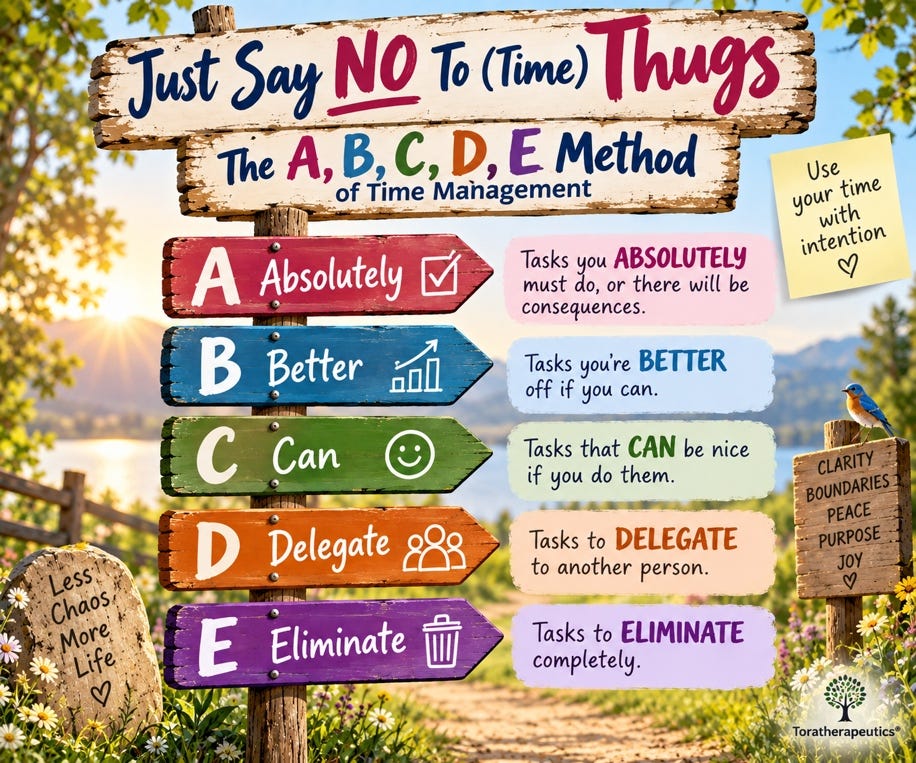
Hillel teaches in Pirkei Avot 1:14: “If I am not for myself, who is for me? And if I am only for myself, what am I? And if not now, when?” The brilliance lies in the tension. Torah does not teach absolute self-sacrifice, but neither does it endorse a life built around personal convenience. Some burdens are sacred. Children wake us; parents need us; communities require us. Friendship sometimes calls at a terrible hour. Avodah is not always ergonomically designed. So, the question is not merely: Does this cost me energy? Everything worthwhile costs energy. The better question is: Is this mine? Is this aligned with my values, responsibilities, gifts, relationships, and actual capacity? There is a difference between sacrifice and leakage. (See my ABCDE graphic below.)
NOT EVERY STRESSOR IS A THUG
This distinction matters. I believe deeply in chosen challenge. Bodies and minds often grow through appropriately dosed stress - hormesis. Exercise stresses muscle. Learning stresses cognition. Difficult conversations can deepen relationships. A nervous system should not be protected from every discomfort. That would not be regulation. That would be shrink-wrapping. A thug is not merely something difficult. A thug is something that repeatedly removes, takes, and detracts more than it gives. It ignores reasonable limits, creates disproportionate disruption, or recruits us into roles that are not ours. One strengthens capacity and provides resilience. The other quietly consumes us and our energy. Discernment is knowing the difference. Sadly, I said yes to so many muggings and ‘thuggings,’ that overwork, along with neglecting my own advice and self-care, eventually caused me to land me what I now call “My Stroke Of Good Fortune.” I had to learn some of these lessons the hard way. We’ll speak more about that in a future article but suffice it to say, that I became considerably more interested in my overall health and in particular my nervous-system stewardship once my own nervous system lodged a rather emphatic complaint. I like the “ABCDE” acronym for time and resource economy.
NO IS SOMETIMES A COMPLETE SENTENCE
Some of us speak doctoral dissertations after the word no. We might respond to the request: “No, because I was thinking that perhaps next week…although if you really need me, I might rearrange something...” The defense rests. Sometimes explanation is respectful and necessary. But sometimes “no” really is a complete sentence. Or, for those of us who need training wheels you may need to begin with not responding in the moment. Say, “I’ll have to get back to you,” or, “Call me tomorrow again.” “I can’t do that.” “That won’t work for me.” “I don’t have the capacity.” “I’m not the right person for this.” “I can give you twenty minutes, but not two hours.” Simple sentences are remarkably cheap metabolically. Resentment is extremely expensive.
ENJOY MY SUNO SONG – NO IS A COMPLETE SENTENCE
THE GUILT TREMOR
Then comes the interesting part. You establish the boundary. Nobody dies. Yet your nervous system behaves as though a minor international incident has occurred. There may be guilt, anxiety, or an immediate desire to retract the boundary. That discomfort is not necessarily proof that the boundary was wrong. Sometimes it is simply unfamiliarity. A nervous system that learned safety through compliance may experience self-protection as danger. New leadership can feel strange to a system accustomed to being governed by urgency. Let the election results settle. Practice this over and over. Let behavioral plasticity, and neuroplasticity do their thing. Over time, the boundary feels good, like an accomplishment, in and of itself.
THE INTERNAL THUGS
The most challenging and interesting thugs may be inside of us. The perfectionist who says nothing is finished until exhausted. The pleaser who believes everyone else’s comfort outranks our sanity and safety. The rescuer who derives identity from being indispensable. The inner critic who runs a twenty-four-hour surveillance state and has apparently never heard of Shabbos, or any similar “island in time and space.” These parts should not be banished. They often developed for good reasons. Perfectionism may once have protected against criticism. Pleasing may have preserved attachment. Hypervigilance may have detected danger. So, saying no to thugs does not mean declaring war on our inner selves. It means removing their deputy badges. We can listen to them, understand them, and appreciate what they once tried to accomplish, without surrendering to their governance. A frightened advisor is still only a deputy, not the ruler of the kingdom. The mo’ach shalit al halev mind - the wiser, choosing mind, is.

THE QUIETER WAR
Our contemporary thugs are sophisticated. They arrive disguised as opportunity, urgency, guilt, invitations, notifications, and other people’s expectations. They arrive in calendars, inboxes, family systems, professional roles, and habits so old we no longer recognize them as choices. They rarely steal our wallets. They steal bandwidth, not our property, but our presence. And perhaps the mature version of “Just Say No” begins there. Not a reflexive refusal. Not from selfishness. Not a withdrawal from responsibility. Discernment. Is this mine? Is this necessary? Is this reciprocal? Is this the best use of what I have been entrusted with? Can I say yes to this without saying no to something more important? Every yes spends something: time, attention, energy, breath, presence, life. Our task is not to hoard those resources. It is to spend them mindfully and deliberately. Saying no to thugs is therefore not about becoming less generous. It is about becoming more available for what deserves our generosity: people we love, avodah, prayer, meaningful work, creativity, and perhaps even silence. The old slogan was simple. Maybe ours can be too. “Just say no to thugs” so you can say yes to life. Because when the nervous system cannot say no voluntarily, the body may eventually find another way – Exhaustion, resentment, withdrawal, addictions, or collapse, G-d forbid. Better to learn the smaller word. “No” is a complete sentence. Sometimes, even a holy one.

SELECTED SOURCES
Alter Rebbe, Rabbi Shneur Zalman of Liadi. Tanya, Likutei Amarim, chapter 12.
Maimonides. Mishneh Torah, Hilchot De’ot 4:1.
Pirkei Avot 1:14.
Devarim 4:15.
Ronald Reagan Presidential Library and Ronald Reagan Presidential Foundation. Historical materials on Nancy Reagan’s “Just Say No” campaign.