LEARNING TO STAY - OBJECT RELATIONS, SAFETY, AND SLOWING DOWN
Rus Devorah (Darcy) Wallen, LCSW, ACSW, CIMHP


This semester, I am teaching two courses at Touro University Graduate School of Social Work, one Advanced Psychodynamic Psychotherapy and the other in Social Work Values and Ethics. It feels meaningful to be teaching these subjects while also being a client and participant in the very kind of therapeutic relationship we discuss and hope to offer to others in need.
For approximately the past year, I have had the privilege of working with a truly wonderful therapist, someone who embodies the core caregiving values and ethical principles we teach: steadiness, reliability, clear boundaries, authenticity, and deep respect for the inner life of another. She is not merely “practicing” these ideals. She lives them. She is creating the holding environment we discuss in theory, the very environment I have tried to provide for my own clients for many years. As I’m sure you’re aware, the professional therapist seeks her own therapy and supervision, which I have throughout my professional life. Finally, after decades of seeking such a witness of my own, I have been blessed, at this particularly important moment in my life, to experience it personally.
What is unfolding in the room is something my clients have described to me for years, but which I am only now beginning to feel from the inside, for myself. I share what follows as a form of personal psychic ‘avodah,’ a reflective offering, born of gratitude, humility (I say I am humble, emphasis on the ‘bull’ 😄), and a willingness to learn what it means not only to teach, provide, and support safety, but to finally receive and inhabit it for myself.
INTEGRATED REFLECTION ON OBJECT RELATIONS, RELATIONAL AVAILABILITY, AND THE SHIFT FROM “I-CBD TO I-CBB”
To understand the ‘slowing’ that is happening in my life now, it feels essential to begin with my early object relations and attachment landscape. I had wonderful parents; may they rest in peace. I was loved, encouraged, and supported. There was no emotional deprivation or trauma in the dramatic or stereotypical sense. At the same time, my mother was an exceptionally busy, capable, and accomplished community leader and professional. She was deeply present for moments that were significant: achievements, milestones, crises, and accomplishments that clearly mattered. When I did something noteworthy, she was there, attentive, proud, responsive. She ‘shepped nachas,’ glowed with pride.
What was far less available was the ordinary relational space: the humdrum, repetitive, maintenance-level moments of daily life, the simple connections. Those moments often faded into the background of her many responsibilities, her productivity, her visibility, and her busyness. Her attention was not absent. It was selective. Over time, I internalized a quiet but powerful relational message that created a clever defensive logic: what is significant receives attention; what is ordinary does not. I did not experience this as rejection. I experienced it as information.
So, I adapted. She was busy; I became busy. I learned everything I could get my hands on. I joined clubs, skied, made music, acted, played sports, hiked. I clung to significance. I became very good at doing things that mattered, and doing them well: solos in concerts, lead roles in performances, class and student council president, excelling in college and social work school, becoming known in my faith community as an entertainer, respected mental health professional, and guest lecturer.
I became engaged, capable, productive, and successful. I did not become needy. I became effective. I learned to secure connection not by asking for more, but by doing more, performing more, giving more. This mock adaptation is what I now call, with a wink 😉 and a sham ICD-10 diagnosis, “I-CBD.”
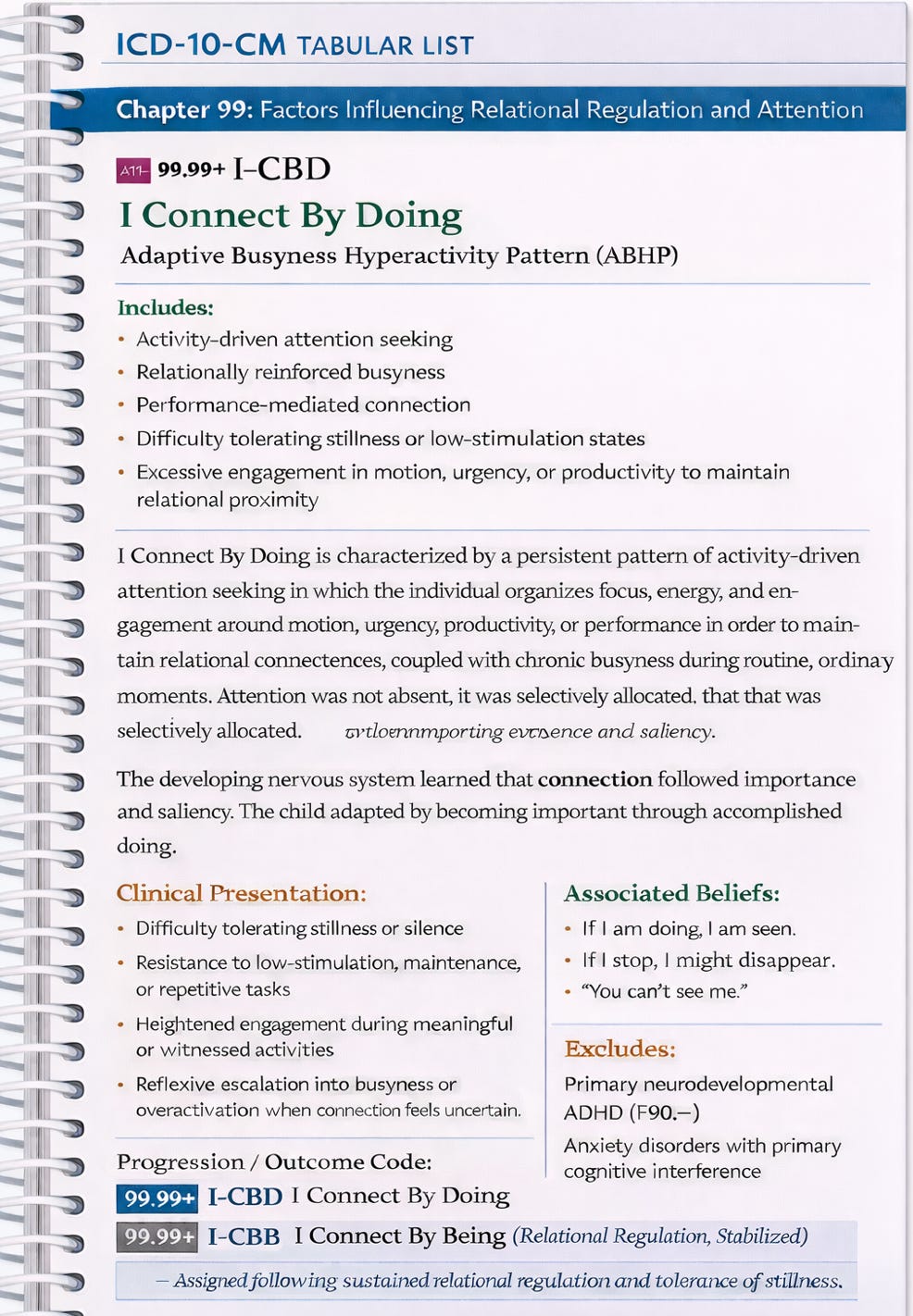
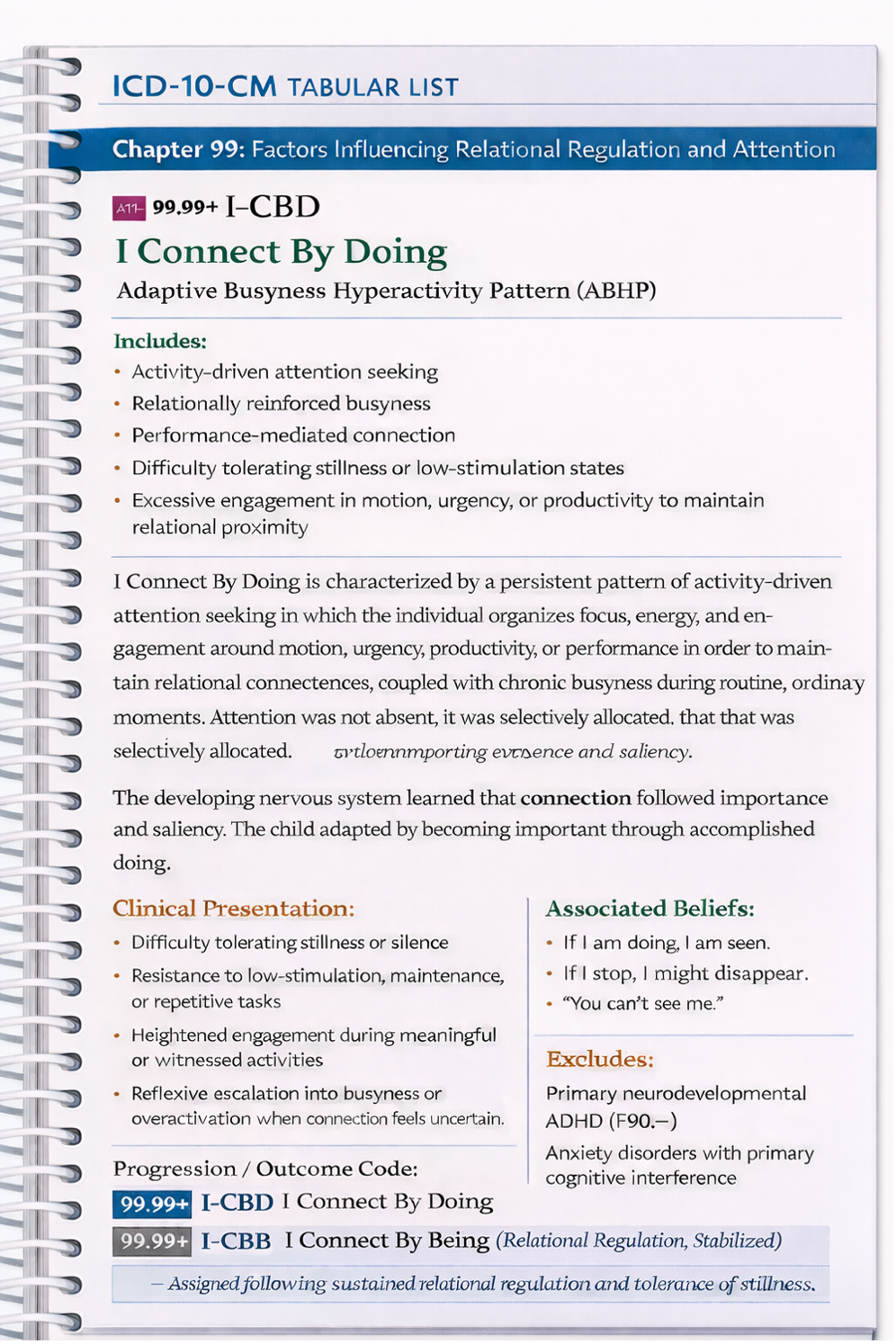
I-CBD: I CONNECTED BY DOING?
Giving, accomplishing, producing, and engaging became my way of staying connected. Importantly, this did not arise from privilege, entitlement, power, or material hunger. In fact, I largely shunned material goods, perhaps because they became increasingly valued by my father and siblings for their own sake, not necessarily their utility or intrinsic value.
ENJOY MY SUNO SONG – I-CBD?
Even now, I feel I have too much stuff. Much of it is lovely and beautiful. Please, do not misunderstand. I appreciate the beauty in Hashem’s creations and creative resources. And yet, I feel fortunate that I am comfortable to receive less than I give. I am appreciative rather than demanding. I do not need to keep score. I love to give to others, without expecting the same or even something equivalent in return. What my nervous system has always needed was not more attention or stuff, but more consistent and reliable attention. The issue was never quantity. It was quality and consistency.
This sensitivity to relational availability shows up clearly in the therapeutic setting. When I began with my therapist, I was running fast, filling spaces that actually needed space themselves (for self-awareness, listening, and hearing). What regulates me most is not unlimited access or constant responsiveness, but reliable availability within a clearly held frame. When expectations, roles, time, and limits are explicit, my nervous system settles. I do not push against boundaries when they are clear. I rest inside them, knowing there is safety in the bounds.
In my Zoom therapy room, simply knowing that I have one protected, uninterrupted, fifty-minute hour each week, consistently and predictably with her, is profoundly regulating in and of itself. Even if every idea I bring in is not fully discussed or processed, even if every excitement of mine is not mirrored, the regulatory container itself does quite impressive work. Now, it’s not just something I’ve “seen in the literature.” I get to feel it, myself.
As safety settles, not only intellectually but somatically and relationally, I notice a shift. I feel less compelled to manage the space, fill the silence, or maintain momentum through my own activity. I am beginning to trust the vessel of the relationship rather than hold it up through effort. As that trust grows, I can offer my therapist more space to offer her own wisdom. Not because it was absent before, but because my system is finally quiet enough to receive it. I filled her space. I am paying for an expert. Let me enjoy her expertise.
This relational shift mirrors what I see with my own clients. The upsetting material spills out, the circumstances and needs become clearer, the pace slows, and rapport deepens. What I am experiencing now personally is the lived and embodied version of what I have long observed clinically, with my clients and in the literature, but as I said before, I feel so fortunate to actually have the opportunity to experience it myself.
THE BODY LEARNS FIRST
Nearly nine years ago, I had what I now call “My Stroke of Good Fortune.” At the time, it was abrupt, dangerous, and non-negotiable. I was running too fast, doing too much, burning the candle at both ends, living at a pace my system could not sustain. My body stopped me because I could not stop myself. As I say, “G-d struck me with a stroke of force to get me in the zone.”
ENJOY - I WANNA THANK YOU FOR THIS LOVIN’ LIFE – Men’s Vocals
The early phase of healing required diligence, but it was diligence imposed from the outside. In Torah language, it resembles the first receiving of Torah at Sinai. The revelation was so intense that the people recoiled. Our sages describe it as וּפָרְחָה נִשְׁמָתָם, their souls flew out of them, unable to remain embodied in the face of such power. Another image describes the mountain held overhead, as if to say this receiving was unavoidable, overwhelming, and pressured upon us.
The early years after my stroke were like that. I slowed because I had to. I listened because the consequences of not listening were terrifyingly clear. That phase was about survival and compliance with limits not yet fully internalized.
Something has shifted, thank G-d. What I am experiencing now is a second phase, qualitatively different. The slowing that is happening is not imposed. It is chosen.
I feel it internally even when it is not visible to others. I am slower in therapy and more tolerant of pauses. In life, I catch myself earlier, before rushing, before tensing, before kitchen or other accidents. I’m catching my impulsivity mid-flight, which helps me pause and not interrupt my therapist or others who stir up emotion in my life.
I slow down my brochos (blessings) and actually taste the foods and individual ingredients. Sleep is deeper and more contiguous. The subtle post-stroke sensations that once signaled nervous system activation have softened and diminished. This slowing is called systemic “regulation.” I am finally beginning to know what it feels like to slow and go to flow.
In Torah terms, it resembles the second receiving of Torah. The second luchos (tablets) were given quietly. The covenant was re-entered not through thunder, but through consent. We said, “na’aseh v’nishma - we will do and then hear and understand.” That reception of the Torah was an act of choosing. The Torah does not change. The vessel does. What was once overwhelming becomes livable through integration and internalization. Choices are no longer foisted upon us.
This is the difference between two kinds of diligence. Not having to, but getting to…The first was a hard corrective strike. The second is a gentle stroke, a glett, like stroking one’s face. Like soothing, self-compassionate care. Diligence without violence. Structure without threat. Discipline without force or fear. Discipline, after all, shares an etymology with disciple. I am finally becoming a disciple/student. I am finally learning at this age and stage. I’m a slow learner, I guess.
A NEW LIVED TRANSITION FROM “I-CBD TO I-CBB”
FROM I CONNECTED BY DOING TO I CONNECT BY BEING
The stroke forced me to stop running. This chosen slowing is teaching me how to stay. In the language of Tehillim, “I have learned to calm and quiet my soul; like a weaned child with its mother; like a weaned child am I in my soul.” (Psalms 131:2) Not because I was overpowered, but because I have learned that I am safe enough to settle.
This feels like the deepest form of healing. Not merely obeying limits but choosing them. Not merely surviving connection, but inhabiting it gently, steadily, and fully. This is no longer a hard stop. It is a caress. A gentle stroke, a glett on the cheek.
I thank Hashem for “My Stroke of Good Fortune” and for the ability to experience true post-traumatic growth, little by little, day by day, integrating it in the most gentle and incremental way. I am also deeply grateful to Him for His gracious Providence, that I am able to experience this mindful slowing with my therapist at this special, blessed stage of my wonderfully productive and increasingly embodied life.

CLINICAL REFERENCES
Ainsworth, M. D. S., Blehar, M. C., Waters, E., and Wall, S. (1978). Patterns of attachment: A psychological study of the strange situation. Lawrence Erlbaum.
Bion, W. R. (1962). Learning from experience. Heinemann.
Bowlby, J. (1969). Attachment and loss: Vol. 1. Attachment. Basic Books.
Fairbairn, W. R. D. (1952). Psychoanalytic studies of the personality. Routledge.
Fonagy, P., Gergely, G., Jurist, E. L., and Target, M. (2002). Affect regulation, mentalization, and the development of the self. Other Press.
Kohut, H. (1971). The analysis of the self. International Universities Press.
Ogden, T. H. (1994). The analytic third. International Journal of Psycho-Analysis, 75, 3–19.
Schore, A. N. (1994). Affect regulation and the origin of the self. Lawrence Erlbaum.
Siegel, D. J. (2012). The developing mind (2nd ed.). Guilford Press.
Taylor, K. (2014). The ethics of caring: Honoring the web of life in our professional caring relationships. Oxford University Press.
Winnicott, D. W. (1958). The capacity to be alone. International Journal of Psycho-Analysis, 39, 416–420.
Winnicott, D. W. (1960). The theory of the parent–infant relationship. International Journal of Psycho-Analysis, 41, 585–595.
TORAH SOURCES
Shemot 19–20
Devarim 5
Shabbat 88a–b
Shir HaShirim Rabbah 5:6
Shemot 32–34
Yoma 86a
Megillah 7a
Tehillim 131:2
This is beautiful and inspiring, illustrating how growth continues to be possible at every stage of life. May you be blessed with many years of good health, continued growth and happiness, just being and being seen.
Thank you for reading and commenting. Yes, at any age and stage 🙌🏻🫶🏻🙌🏻