

“What you resist persists” is one of those compact little sayings that can sound either deeply wise or suspiciously suitable for a decorative pillow. Yet beneath the slogan lies a serious truth about the nervous system, the unconscious, and the peculiar human talent for strengthening the very experiences we are trying to eliminate. I began thinking about this while reading Howard Schubiner’s wonderful book Unlearn Your Pain. Much of his approach resonates with ideas I have long held about calming the nervous system so that the body can begin to realign. The body often does not need to be bullied into functioning better. It needs enough safety to stop devoting so much of its intelligence and energy to protection (Schubiner, 2026).
When the nervous system interprets a sensation as dangerous, it mobilizes around it. Attention narrows; muscles brace; breathing changes; vigilance increases. The brain begins monitoring the body for additional evidence that something is wrong. Then we resist the sensation: “Oh no, there it is again. Why is this happening? What if it becomes worse? How can I make it stop?” The brain listens carefully to our inner narrative reaction and concludes, “Apparently this is important. We had better keep watching it.” Resistance becomes attention. Attention increases salience. Fear gives the sensation meaning. The alarm becomes evidence of danger, and our fearful response becomes evidence that the alarm was necessary. The nervous system has hired a full-time security guard to patrol the very experience we wanted evicted in the first place.
This is not to say that pain is imaginary, that every pain is produced by fear, or that medical symptoms should be philosophized away. Pain is real, and pain can signal injury or illness. But in some persistent pain conditions, the original danger may have passed while the protective system continues sounding its alarm. Neural pathways related to pain, threat, attention, expectation, and avoidance can become reinforced, and research suggests that in some forms of primary chronic pain, new experiences of safety and reinterpretation can help revise those patterns through therapeutic techniques called Pain Reprocessing Therapy (Ashar et al., 2022, 2025).
There is often a first experience and then a second suffering layered around it. There is pain, followed by fear of pain. Anxiety, followed by anxiety about anxiety. Sadness, followed by shame about sadness. Wakefulness, followed by panic about not sleeping. An unwanted thought, followed by a vigorous campaign never to think it again. The original experience may be difficult, but the battle against having it can give it staying power. Trying desperately to sleep can keep us awake because sleep does not respond well to pressure. The more insistently we demand it, monitor for it, and calculate its absence, the more alert the nervous system may become. Likewise, trying not to think a thought requires the brain to keep checking whether the forbidden thought has appeared. The mental bouncer must carry a photograph of the prohibited guest. Experimental research on thought suppression has demonstrated this paradox rather elegantly (Wegner et al., 1987). So, when a client who has nausea says, “I can’t eat.” I say, “Don’t worry, you don’t need to. So, drink if you can.” OR “I can’t sleep.” “So, close your eyes, and think of something nice. You don’t need to sleep, just rest.”
The same principle appears during my massage. I know there are tender places that will hurt when pressed a certain way. Yet I choose the massage as a therapeutic endeavor using a trusted the practitioner and always retaining the power to ask her to lessen or stop the pressure. The sensation is sometimes painful, but it is not interpreted in quite the same way as an unexpected assault upon my body would, G-d forbid. The pressure said, “Intensity.” Choice, trust, and meaning said, “But not dangerous, on the contrary, most likely, therapeutic.” Rather than rigidly bracing against the tender place, I can breathe, and lean toward and into the sensation, and soften around it. Not every painful pressure is beneficial, and certainly not because overwhelming pain should be endured, but an appropriately dosed challenge can sometimes invite adaptation. We’ve spoken about hormesis here before. Hormesis describes the capacity of biological systems to adapt beneficially to certain moderate challenges, while also reminding us that dose matters enormously (Calabrese & Mattson, 2017). As the phrase goes, “Sola dosis facit venenum - The dose makes the poison.”
This is the principle of Chosen Challenge. The same cold water feels different when I turn the dial myself and choose the temperature. I know what is coming. I understand why I am doing it. I can stop. The difference is obviously not only in the water. The difference is not only in the pressure. The difference is in my choosing. Research on stress controllability likewise suggests that perceived control can substantially alter how organisms respond to aversive experience (Maier & Seligman, 2016). A manageable challenge may promote adaptation rather than helplessness. The art lies at the edge, not in the abyss. Too little challenge produces no new learning. Too much can overwhelm the system and confirm its fear. But a chosen, meaningful, tolerable challenge can teach the body, “I can experience intensity without converting it into emergency.”

This brings us directly to Avoidah*, my playful word for an Ashkenazic pronunciation of the word avodah (work/service/job), with a little avoidance tucked mischievously inside. Avoidance is extraordinarily effective in the short term. That is why it is so difficult to relinquish what we usually cannot control to begin with. When we avoid something frightening, our distress immediately decreases, and the brain records the lesson: “Yay! I escaped. Therefore, there must have been danger. Therefore, I should escape again.” The relief rewards the avoidance. Each escape lowers distress now while quietly teaching the nervous system to become more distressed next time. Contemporary exposure models describe precisely this problem: avoidance prevents the nervous system from learning that the feared experience can sometimes be encountered without the expected catastrophe (Craske et al., 2014).
*We will discuss “Avoidah” at greater length in another article, be”H.
Avoidah can become the devoted practice of arranging one’s life around not encountering something. We avoid the task that might expose our inadequacy. We avoid stillness because grief may arrive. We avoid visibility because people might judge us. We avoid intimacy because attachment creates vulnerability. We avoid beginning because beginning opens the possibility of failure. The nervous system has tremendous respect for repetition. Unfortunately, it does not always ask whether the thing being rehearsed is courage or retreat.
And now Carl Jung wanders into our discussion carrying his shadow (and may have been the originator of our title’s rhyme 😉). Sometimes what we resist is not merely an unpleasant sensation. It is an unrecognized part of ourselves. Jung used the shadow to describe aspects of personality that have been excluded from conscious identity and are therefore more likely to emerge indirectly, particularly through projection and emotional reactivity (Jung, 1968). The shadow may contain qualities the conscious personality has disowned because they seem shameful, dangerous, unacceptable, or inconsistent with the person we believe ourselves to be. It may contain anger, envy, aggression, dependency, selfishness, grief, vulnerability, or desire. But it may also contain confidence, creativity, authority, playfulness, ambition, power, and brilliance. Not everything banished into the shadow is dark. Some of it is simply too bright for the identity we were permitted to construct.
The psyche does not reliably dispose of what we disown. It merely removes it from conscious supervision. Rejected material may then return through projection, symptoms, compulsions, disproportionate reactions, or recurring relational patterns. We keep encountering people who seem to carry the very qualities we cannot acknowledge in ourselves. Sometimes our perceptions are accurate. Not every irritation is a projection, and some people really are irritating. The world remains generously supplied. But the intensity of our reaction may occasionally reveal that the other person is carrying something that belongs partly to us.
This is where the phrase becomes more interesting: Sometimes what we resist persists because it contains something we need. Anger may contain a neglected boundary. Envy may reveal an unlived desire. Control may conceal terror of being out of control. Neediness may carry legitimate attachment hunger. Grief may reveal the depth of love or loss. Rebellion may contain moral courage. The “too much” child may be guarding creativity, leadership, enthusiasm, or an enormous capacity for connection. The shadow’s first presentation may be unruly, but the energy within it may be valuable. Integration does not mean obeying every impulse. Discovering aggression does not require throwing a chair. It may allow us to reclaim firmness, protection, protest, or courage. We entertain the shadow as one entertains a guest. We invite it inside, offer it a chair, and listen to what it has brought. We do not automatically give it the key combo, the master bedroom, or the deed to own the house.
In IFS language, some of this territory resembles what Richard Schwartz calls “the exile,” although a Jungian shadow and an IFS exile are not identical concepts. An exile is often a younger, wounded part carrying shame, fear, loneliness, helplessness, or unmet attachment needs, while other parts become protectors assigned to prevent that pain from overwhelming the system (Schwartz & Sweezy, 2020). The exile may carry: I am unlovable. I was abandoned. I am powerless. I am too much. The protectors respond: We will never need anyone again. We will remain perfect. We will control every variable. We will stay constantly busy. We will numb, distract, procrastinate, please, perform, intellectualize, or disappear. Avoidah may therefore become the protector’s full-time occupation. It is the internal system organized around preventing contact with what has been exiled.
Sadly, and somewhat ironically, what we avoid often not only persists but grows. The feared thing gathers power in absentia. Each retreat can make the next encounter feel larger, more threatening, and more difficult, until the anticipation itself becomes part of the suffering. This also deepens the massage metaphor. The tender point resembles the exile. The muscular bracing around it resembles the protector. If the practitioner attacks the knot too forcefully, the body may guard it even more intensely. Likewise, if we tear past protectors and drag an exile into consciousness before the system is ready, the psyche may become more defended rather than less. The healing movement is relational: I understand why you are guarding this place. I will not force my way past you. Can we approach it slowly? Can I feel only as much as is manageable? That is Chosen Challenge within the psyche. There is consent, pacing, meaning, and the ability to stop. The Self does not storm the exile’s cave with stadium floodlights. It approaches with curiosity, compassion, and a small lantern.
And here we arrive at the Torah principle that holds the entire discussion together: Yerida l’tzoreich aliyah, descent for the sake of ascent (of a greater magnitude). Shadow work requires a deliberate descent beneath the persona, beneath the protectors, beneath the polished story we ordinarily tell about ourselves. But we do not descend merely to rummage indefinitely through the psychological basement. We descend to retrieve something. When a wounded part was banished, some of its vitality may have been banished with it. The ascent occurs when the pain is witnessed, the burden begins to loosen, and the trapped life force is brought home.
Avoidah refuses the descent: I will remain safely above this. I will not feel it. I will not remember it. I will not discover what it asks of me. But refusing the yeridah may also prevent the aliyah. We remain on the upper floor, perhaps impressively functional, while portions of the self, continue living unvisited in the basement.
Avodah says: I will descend carefully. I will bring light, support, discernment, and compassion. I will not become the darkness I encounter. I will return carrying something I could not have recovered from above. Not every descent is chosen. Some are imposed, unjust, traumatic, and utterly unwanted. We should never romanticize suffering or pretend that every wound was desirable because growth eventually emerged from it.
We may not choose the pit. We may later choose whether, when, and how to enter its meaning. We may choose to return for the part of ourselves that was left there. The wound does not become good. It simply does not receive the final word.

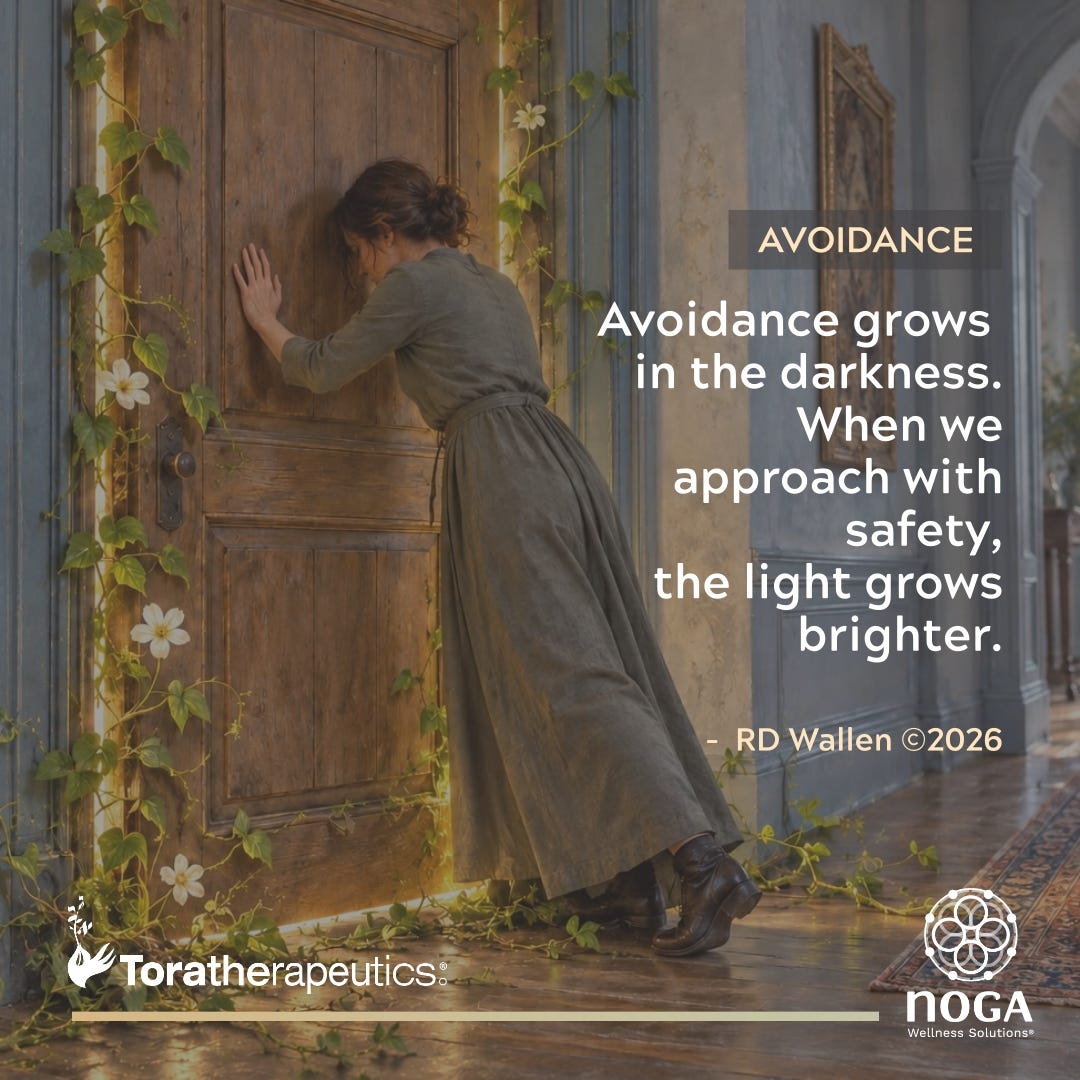
The whole map now comes together. “What you resist persists” describes the paradox. The shadow points toward what has been resisted, the exile carries what was banished, and the protectors perform the Avoidah that keeps it out of reach. Nervous-system safety creates the capacity to approach it; Chosen Challenge offers a tolerable path toward it; avodah gives the encounter meaning and direction; and yerida l’tzoreich aliyah describes the movement of descent, retrieval, and return. Perhaps the deepest truth is not merely that what we resist persists, but that what persists may still be carrying something necessary for our wholeness. Avoidance grows in the darkness. When we approach with safety, the light grows brighter. What has been exiled does not necessarily want to rule us or torment us. It may simply be waiting to be recognized, understood, refined, and brought home. What we resist remains in exile, and what remains in exile continues to call. What we approach with safety can become conscious, and what becomes conscious can enter our avodah. When we return carrying the lost part, the descent itself becomes the beginning of ascent.
REFERENCES
Ashar, Y. K., Gordon, A., Schubiner, H., Uipi, C., Knight, K., Anderson, Z., Carlisle, J., Polisky, L., Geuter, S., Flood, T. F., Kragel, P. A., Dimidjian, S., Lumley, M. A., & Wager, T. D. (2022). Effect of pain reprocessing therapy vs placebo and usual care for patients with chronic back pain: A randomized clinical trial. JAMA Psychiatry, 79(1), 13–23. https://doi.org/10.1001/jamapsychiatry.2021.2669
Ashar, Y. K., Low, E. L., Knight, K., Schubiner, H., Gordon, A., LeRoux, A., Lumley, M. A., & Wager, T. D. (2025). Pain reprocessing therapy vs placebo and usual care for patients with chronic back pain: 5-year follow-up of a randomized clinical trial. JAMA Psychiatry, 82(10), 1049–1051. https://doi.org/10.1001/jamapsychiatry.2025.1844
Calabrese, E. J., & Mattson, M. P. (2017). How does hormesis impact biology, toxicology, and medicine? npj Aging and Mechanisms of Disease, 3, Article 13. https://doi.org/10.1038/s41514-017-0013-z
Craske, M. G., Treanor, M., Conway, C. C., Zbozinek, T., & Vervliet, B. (2014). Maximizing exposure therapy: An inhibitory learning approach. Behaviour Research and Therapy, 58, 10–23. https://doi.org/10.1016/j.brat.2014.04.006
Jung, C. G. (1968). Aion: Researches into the phenomenology of the self (R. F. C. Hull, Trans.; 2nd ed.). Princeton University Press. (Original work published 1951)
Maier, S. F., & Seligman, M. E. P. (2016). Learned helplessness at fifty: Insights from neuroscience. Psychological Review, 123(4), 349–367. https://doi.org/10.1037/rev0000033
Schubiner, H. (2026). Unlearn your pain: The science of recovering from chronic pain, fatigue, anxiety, and depression. The Open Field.
Schwartz, R. C., & Sweezy, M. (2020). Internal family systems therapy (2nd ed.). Guilford Press.
Wegner, D. M., Schneider, D. J., Carter, S. R., III, & White, T. L. (1987). Paradoxical effects of thought suppression. Journal of Personality and Social Psychology, 53(1), 5–13. https://doi.org/10.1037/0022-3514.53.1.5
Darcy I love “Avoidah” and way you bring together how the critical role descent plays in our lives to enable the ascent. Shana Tovah!
A powerful message beautifully written. Shana Tova 🙏